


If you mention artificial intelligence (AI) in a conference room right now, you can practically watch the emotional spectrum play out in real time. One person is excited because it just saved them an hour of administrative work, while another is overwhelmed because it feels like one more technology they're supposed to master. A third is quietly hoping it doesn’t replace them.
AI has quickly woven itself into everyday life, helping us plan trips, write emails, and forecast business demand. Now, it is being built into the healthcare system, employee benefits, and workforce mental health programs.
For HR and benefits leaders, the question is no longer whether AI belongs in mental health. It's already here. The critical questions now are how it's being designed and governed, and whether it aligns with an industry that must continue to be built on safety, trust, and clinical responsibility.
The efficiency gains of AI are attractive. We all understand this. But the risks of implementing AI without the right guidance are significant. Navigating this landscape requires understanding the difference between AI as a cost-cutting replacement for care and as an enablement layer that strengthens human connection and engagement.
The current state of AI and informal usage
The use of AI in everyday life is wide-ranging, and that extends into how people process stress, emotions, and wellbeing. Many people are using AI informally to reflect, organize their thoughts, or better understand what they're experiencing.
This pattern is especially noticeable among younger individuals. According to a recent national survey published in JAMA Network Open, about 13 percent of people ages 12 to 21 in the United States—estimated at roughly 5.4 million—have turned to generative AI for mental health guidance. The rate climbs to more than 22 percent for those 18 and older. Among these 5.4 million users, more than six in 10 reported checking in at least monthly, and the vast majority, over 90 percent, found the guidance helpful.

From a clinical perspective, this behavior tells us that people are seeking support earlier. They're looking for outlets that feel accessible, immediate, and non-pathologizing. Traditional employee assistance program (EAP) models often require a level of activation, such as calling a number, navigating a website, or waiting for an appointment. But we know that doesn't always align with how people experience distress in the moment.
This rapid adoption raises several concerns that simply can't be overlooked. Many of the general-purpose tools being used for these sensitive conversations were not designed for mental health contexts. They lack the clinical safeguards, escalation pathways, and continuity required when emotional risk is present.
The risks of unguided AI in employee mental health
The most significant risks regarding AI in mental health involve safety, scope, and oversight. Mental health care requires clear boundaries around what technology can and cannot do.
Risks arise when AI systems are optimized for engagement without proper escalation protocols in place. Some consumer-grade AI models are being driven less by clinical evidence and more by economic pressure, using AI to offset clinician costs rather than to improve care quality.
There are some common "red flags" to be wary of in AI-enabled mental health solutions, particularly those that:
- Position AI as a replacement for licensed care. If a solution uses AI as the primary or required entry point to care, such as AI-led crisis intervention or intake assessments, it may be prioritizing cost savings over safety.
- Lack transparency around human oversight. Automated systems must have clear thresholds for when a human clinician takes over.
- Cannot articulate risk management. Mental health risk evolves over time. An AI system that treats every interaction as an isolated event may miss the pattern of deteriorating mental health.
As Matt McCreary, CuraLinc’s Chief Product Officer, shared, “AI can be a valuable tool in mental health, but it’s not a substitute for clinical judgment or human connection. We need to recognize the limitations, put strong guardrails in place, and ensure that technology supports—not overrides—the expertise of mental health professionals.”
Without persistent risk detection and human handoff, unguided AI can inadvertently delay appropriate care or provide advice that exacerbates a user's condition.
A clinical-first approach to AI in workplace mental health
To mitigate these risks while capturing the benefits of innovation in mental health, AI must be viewed as a clinical support tool rather than a new way to deliver care. This is a clinical-first approach.
In this model, AI operates within defined guardrails and under licensed clinical oversight. It doesn't make clinical decisions or replace human judgment. Instead, it supports clinicians by reducing administrative burden and enhancing quality monitoring.
A survey from the National Council on Mental Wellbeing found that 68% of the behavioral health workforce says administrative tasks like scheduling, documentation, and coding often take away from the time they could be directly supporting clients. That's where AI tools can help. By automating these ongoing and necessary tasks, we can allow clinicians to do more of the meaningful work—the work that drives outcomes and truly changes lives.
"At CuraLinc, we’ve been intentional in taking a different path," explains Matt. "We view AI as an enablement layer, not a care model. It supports clinicians, improves efficiency, and expands access, but it never replaces licensed care or clinical accountability."
Benefits for Employees: Lowering Barriers
When designed responsibly, AI also offers significant advantages for employees, helping to reduce barriers and improve access to support.
Immediate validation
Traditional pathways to care, like navigating phone trees or complicated portals, or waiting weeks to speak to a licensed clinician, can feel overwhelming, particularly during moments of distress. In contrast, an AI-enabled digital experience provides a sense of immediacy and psychological safety, allowing employees to access resources the moment they need them. This immediate support can make it easier for employees to take that important first step toward care. AI can make it easier to schedule care or to start with self-guided resources designed with clinical oversight.
Increased personalization
There is a tremendous opportunity to use AI to further personalize blended care plans. For example, CuraLinc uses personalized recommendations and clinically validated check-ins, similar to how a fitness app reminds you to stay active. Tailored nudges and personalized resources encourage employees to stay engaged in their own wellbeing journey and reinforce positive habits over time. Oftentimes, real improvement is driven by what happens in the moments in between sessions. An AI-enabled platform designed for humans and grounded in clinical oversight acts as a bridge, helping to sustain progress long after a session ends.
Reduced stigma
AI tools give employees a judgment-free space to pause, reflect, and make sense of their own internal experience, without the stigma that some people associate with seeking help. For many, especially those who are not ready to speak with another person, this can build confidence and readiness for further care when it’s needed most.
Overall, AI helps create multiple touchpoints that make mental health care easier to access and less intimidating, giving employees space to take charge of their wellbeing at their own pace and comfort level, while creating a clear path to additional resources when a higher level of support is needed. This approach aligns with the concept of clinically appropriate care.
Benefits for employers
You can realize meaningful value from AI through more effective care routing, earlier intervention, and measurable outcomes. By partnering with an EAP that thoughtfully integrates AI into your mental health strategy, you can create pathways for proactive support, ensure your employees receive the right care at the right time, and gain insights to help inform future decisions.
Care routing and efficiency
One of the costliest inefficiencies in workforce mental health is the misalignment of care. If every stressed employee is funneled into long-term psychotherapy, utilization costs rise without necessarily improving outcomes. On the other hand, if high-risk employees are left to navigate phone trees and waitlists, care gets delayed, performance can decline and risks can escalate.
AI can enhance the intake and assessment process, helping to identify needs with greater precision. This helps ensure employees are routed to the most effective modality immediately, whether that is a mental health coach, a licensed counselor, or self-care resources and tools.
Reducing downstream risk
By lowering the barrier to entry and increasing clinically guided personalization, AI encourages utilization and engagement, especially among employees who might otherwise wait until a crisis occurs. And we know that early intervention is key to preventing high-cost claims.
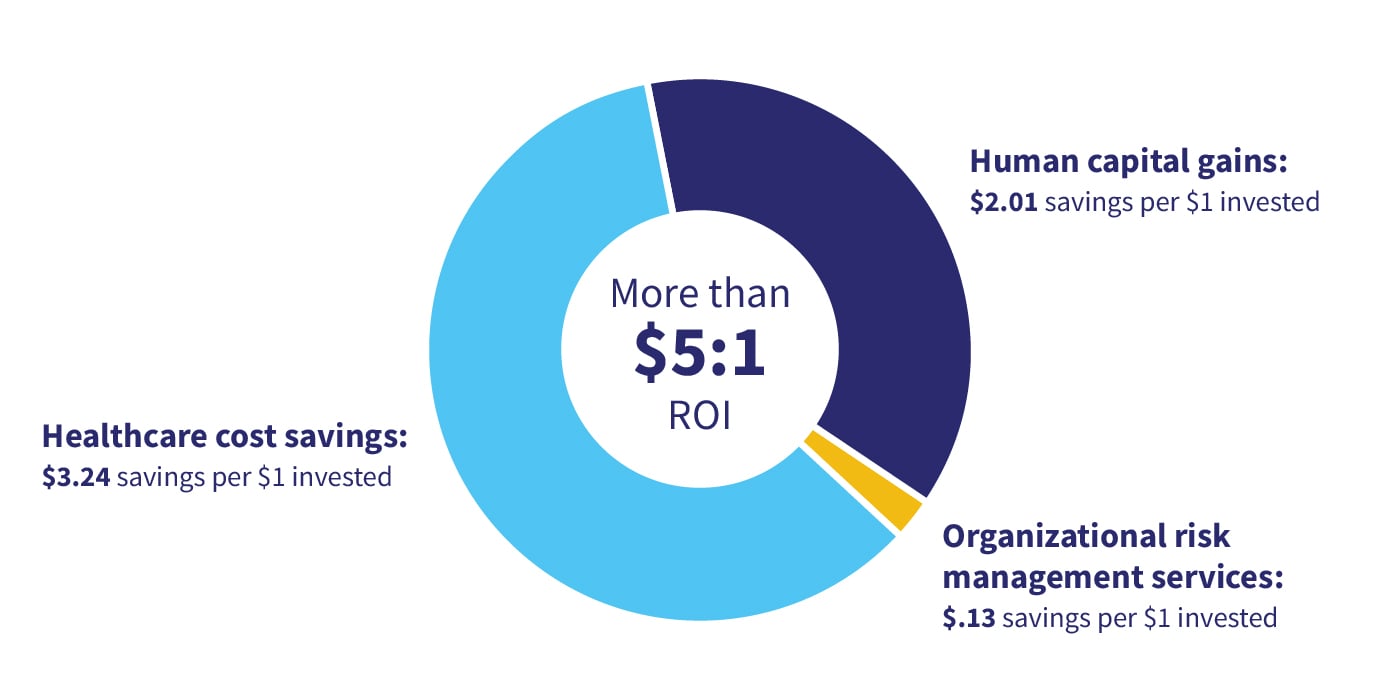
CuraLinc's peer-reviewed study demonstrates that resolving mental health concerns within the EAP avoids high costs. For every $1 invested, the program generates an average return of more than $5:1. This ROI is driven by distinct factors:
- Healthcare cost savings: $3.24 savings per $1 invested
- Human capital gains: $2.01 savings per $1 invested
- Organizational risk management services: $.13 savings per $1 invested
AI can contribute to this financial impact by engaging employees earlier in the acuity curve, preventing escalations that lead to high-risk medical claims and lost productivity.
The future is human-led and AI-enabled
The integration of AI into workforce mental health isn't about choosing between technology and humanity. It's about using technology to make the human elements of care more accessible, effective, and sustainable.
As you evaluate workforce mental health solutions, it's critical to take the time to understand how AI is being used. Solutions that promise to replace clinicians or slash costs through total automation should be viewed with skepticism. Remember that mental health support involves nuance, judgment, and relational context that algorithms simply can't replicate.
The future of workforce mental health is a synergy of human clinical expertise and AI-enabled innovation. By partnering with an EAP that prioritizes safety and clinical integrity, you can build a benefits strategy that truly supports the whole employee and your business goals.
Go deeper on AI in workplace mental health benefits
In our recent episode of Coffee with CuraLinc, Chief Product Officer Matt McCreary dives deep into the influence and risks of AI in employee mental health care. He discusses the specific guardrails CuraLinc uses to ensure safety and why "dependency" is a bug, not a feature, in responsible AI design.
Watch the full conversation on AI in Mental Health Care →
FAQs