


When your team shares a physical office space, identifying employee stress is often a matter of observation. You can see when someone constantly stays late or begins to withdraw from casual breakroom conversations. But when you have a remote workforce, that visibility disappears.
For anyone who supports the overall employee experience, this presents a unique challenge. You're responsible for the health and productivity of employees, but you're unable to rely on traditional office cues. Simply asking "How are you?" during a video call probably won't yield a transparent answer.
That's why you must have intentional systems in place to identify risk early and proactively support employees. By learning to recognize shifts in digital behavior, training your managers, and leveraging a reliable employee assistance program (EAP), you can build a safety net that catches employees before they hit a crisis point.
Common causes of burnout in a remote workforce
Knowing the most common causes of burnout among remote employees is important to proactively addressing the challenge. While they may vary by industry and even departments, some of the most common challenges include:
- Feelings of loneliness. Remote employees may experience isolation and a lack of social connection due to limited face-to-face interaction with colleagues.
- Working longer hours. The boundaries between work and home can blur, making it easier for employees to extend their workday, often without realizing it.
- Difficulty disconnecting from work or an "always-on" culture. The pressure to be constantly available can prevent employees from taking necessary breaks or fully disengaging after hours.
- Lack of communication. Working remotely can limit casual check-ins and feedback, leading to uncertainty and frustration about expectations or company priorities.
- Feeling unsupported or undervalued. Without regular recognition or visible leadership support, remote workers may feel their efforts are overlooked, which can impact engagement and morale.

Without strong communication, and proper support and resources in place, these challenges can quickly lead to burnout among remote employees. But in order to proactively address burnout, you have to know how to spot it.
The hidden indicators of burnout in a remote workforce
In a remote environment, you have to move beyond physical cues and start paying attention to digital behavioral shifts. Burnout, anxiety, and depression often manifest through changes in how an employee interacts with your company's digital tools. Some key digital indicators of burnout include:
- Communication shifts. You may notice delayed response times, sudden changes in messaging patterns, increased irritability, or employees sending emails late at night.
- Virtual withdrawal. This may look like turning off cameras during meetings, reduced participation in group chats, or missing key deadlines.
- Overwork signals. "Always-on" habits, such as logging in on weekends or consistently working outside standard hours, can also signal burnout.
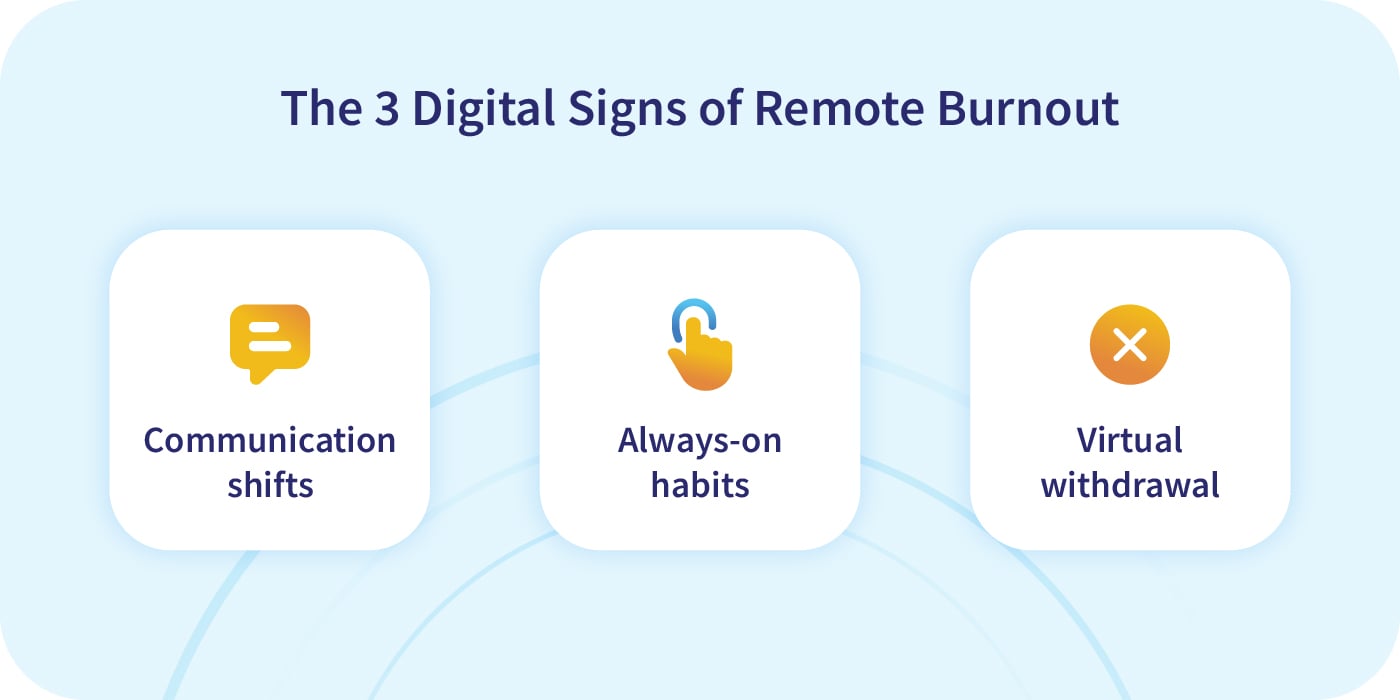
One of the most common indicators is a shift in communication cadence. An employee who usually responds to messages promptly might start taking hours or days to reply. Alternatively, you might notice the "always-on" phenomenon, where an employee sends emails late at night and logs into systems on weekends. When the boundary between home and work is no longer there, employees often feel pressure to prove they're working, leading to chronic overwork.
Another sign is declining engagement in virtual spaces. If a normally active team member suddenly stops turning on their camera during meetings, stops contributing to group chats, or misses deadlines, they may be struggling. Identifying these patterns requires a keen eye and a willingness to look beneath the surface of daily operations.
Proactive strategies to combat remote worker burnout
Now that you can identify the signs of burnout among your remote workforce, we'll discuss what you can do to help combat it. These are tangible strategies and best practices that you can implement to help prevent burnout and support overall employee wellbeing.
Empower your managers through training
Managers are your eyes and ears on the ground. However, leading a remote team requires a different skill set than managing an in-person group. To protect your workforce, your culture must be strategically designed to support managers as active advocates, not just decision-makers or problem-solvers.
Training remote leaders to recognize subtle mental health challenges can be implemented in coordination with your employee assistance program (EAP). With the right support, managers can learn to spot the digital indicators of burnout and, more importantly, how to address them appropriately. Training can also help leaders build the confidence necessary to initiate compassionate, low-pressure conversations and to direct employees to helpful benefits and resources.
Implement data-driven pulse checks for proactive monitoring
Managers play an important role in shaping employees' work environment, but you shouldn't rely entirely on them to spot burnout. They are susceptible to the same pressures and face unique challenges in their own roles. This is where data-driven pulse checks become incredibly valuable.
Implementing anonymous employee feedback loops to monitor wellbeing trends across your remote workforce creates another touchpoint. You can use short, frequent pulse surveys to help gauge team morale and workload manageability. By analyzing anonymous data, you can identify departments or roles at high risk of burnout and respond quickly in coordination with other HR teams and managers.
Leverage your EAP to prevent burnout
Identifying burnout is only half the equation. When remote employees are struggling, they need immediate access to human-centered support—not a phone tree or a long waitlist.
An effective employee assistance program (EAP) for remote teams offers 24/7 access to licensed clinicians so your employees can get the right care at the right time, not just during business hours. Additionally, remote employees may find text coaching and anonymous virtual support groups helpful, while self-guided tools can help prevent burnout by supporting wellbeing at their own pace.
Providing a variety of care options and consistently promoting them in coordination with your EAP vendor helps ensure employees can access support that fits their schedule and comfort level.

Build a culture that supports mental health
Company leaders play an essential role in creating a workplace culture that is proactively committed to preventing and addressing burnout. They can show support by sharing the ways they care for their own mental health. This can include taking their vacation time, declining meetings outside of work hours, and setting clear boundaries for rest.
In addition, internal communication channels, such as your company intranet, employee newsletters, and Teams or Slack channels, can be used to promote mental health benefits and and any self-guided resources. Companywide trainings on how to prevent and identify burnout also let employees know that mental health is a priority in your organization.
Sustaining employee wellbeing in a remote world
The shift to remote work permanently altered how your employees work, impacting everything from communication to expectations. And while it introduced significant benefits, it also obscured the early warning signs that were easier to see in an on-site work environment.
The good news is that by establishing intentional systems to identify and respond to burnout early, you can bridge this visibility gap and create a stronger, more supportive culture.
FAQs