


Your employees bring their whole selves to work. That means the stressors of life don’t stay at home. Anxiety, depression, and emotional strain often clock in right along with them.
Employees experiencing mental health challenges may have difficulty focusing, staying awake, or managing their emotions in a safe way. In turn, their ability to identify hazards and respond safely can decline significantly. And that can show up in any environment, from warehouses and healthcare settings to transportation routes, construction sites, and call centers.
Workplace safety is about more than physical hazards
This connection between mental health and safety is frequently overlooked, but understanding it is an important part of any workplace safety strategy. As an employer, you must consider that while safety incidents affect employees first, they can influence medical costs, workers’ compensation claims, productivity, and more, including your company and brand reputation.
If you want a safer and more productive workplace, mental health has to be a part of the discussion, not an afterthought or a separate set of trainings and policies. This is true across every industry. An effective safety strategy is one that looks beyond common physical hazards and intentionally considers employees' mental and emotional states.

What does research say about mental health and workplace safety risk
The link between mental health and workplace safety has been shown in large-scale research across industries.
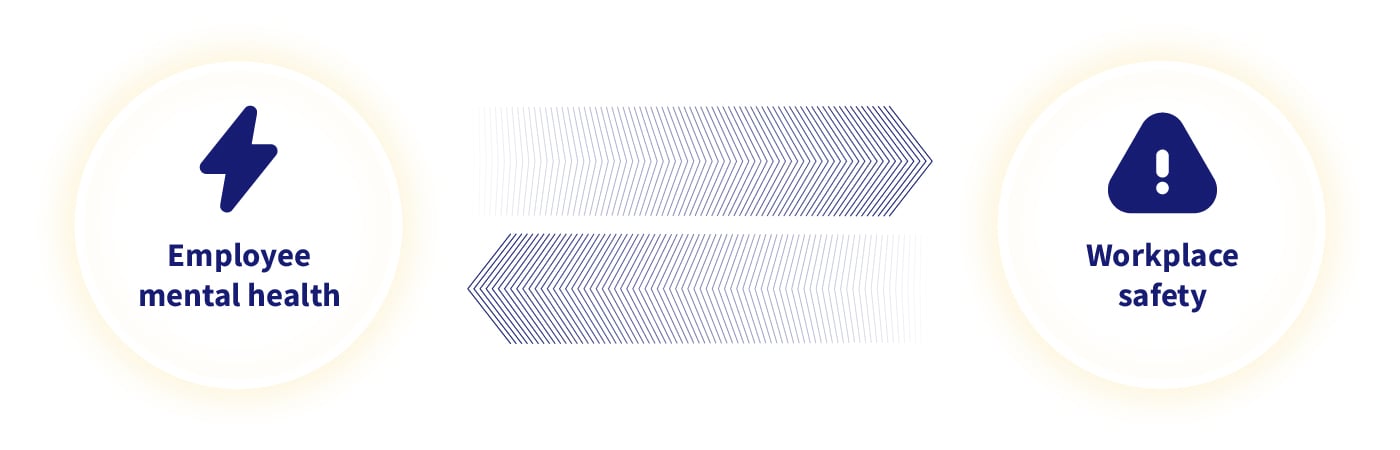
Bidirectional connection between work injuries and mental health challenges
In a U.S. longitudinal analysis of 69,066 employees, episodes of clinical depression significantly predicted future work-related injuries, even after researchers accounted for prior injuries.
The same study also found that the relationship can move in both directions. Workplace injuries can increase the risk of later depression. That creates a cycle many employers know well. It begins when an employee gets injured. Recovery affects their work and home life; stress increases, and mood declines. Eventually, returning to full function becomes harder.
Job conditions impact mental health and safety
Job conditions also impact mental health and safety. A study of 60,000 workers found that those with high job strain were more than twice as likely to be injured as those with low strain. In addition, high role conflict increased injury risk by 3.01 times, while high emotional demands increased risk by 1.96 times.
The challenge is often that job strain and role conflict aren’t visible. There’s no spot for them on a common safety checklist. An employee may have the right equipment, complete the required training, and work in a physically compliant environment, while still facing unclear expectations, overwhelming demands, or emotional pressure that affects their ability to work safely.
For that reason, it helps to reframe the way your organization thinks about safety and creating a culture of safety. It’s not a matter of certain jobs being more hazardous than others. Mental health can affect safety risk across roles and work environments.
Why mental strain leads to physical accidents
To understand why mental health affects safety, it helps to look at what stress, anxiety, depression, and related symptoms do to the brain and body.
Mental strain can reduce the very capabilities employees rely on to work safely, such as focus, memory, reaction time, risk assessment, emotional regulation, and more.
These symptoms can show up at any moment, whether someone is operating equipment, speaking with a customer, or entering important data.

The high cost of workplace safety incidents
Countless studies have shown that workplace safety isn’t just a financial risk for your business, but also a larger, costly risk for society as a whole.
Consider that:
- Liberty Mutual’s 2025 Workplace Safety Index estimated that employers paid more than $1 billion per week for direct workers' compensation costs for disabling, non-fatal workplace injuries.
- The National Safety Council estimated that work-related deaths and injuries cost the nation, employers, and individuals more than $1.3 trillion in 2023.
- The International Labour Organization estimates the economic burden of poor occupational safety and health practices is estimated at 4 percent of global Gross Domestic Product each year.
The costs associated with safety alone are just one of the many reasons why mental health support shouldn’t sit apart from safety culture. You have to consider the financial risk to your business in both the short and long term.
Building a safer workplace through mental health support
Employers can reduce mental health-related safety risks by making psychological health part of everyday safety culture. This doesn’t mean your HR team should diagnose employees or that managers have to act like clinicians. It means your company leaders strategically create conditions where employees know mental health matters. They support an environment where warning signs are noticed earlier, and the right level of support is easy to access.
Acknowledge mental health as a safety priority
The first step is naming mental health as part of workplace safety.
Many organizations already talk about preventing injuries, reducing hazards, and building a culture of care. Mental health belongs in those discussions.
Make a conscious decision to include mental health in safety communications, such as manager meetings, benefits communications, executive updates, breakroom communications, and town hall meetings.
Doing so helps educate employees about the available support resources. Your employee assistance program vendor can help facilitate these communications and conversations.
This shift also helps safety and benefits teams work together. Identify who is responsible for safety data, such as incident rates, lost time, and compliance. Then consider what your HR teams are already tracking, such as leaves of absence, turnover, and healthcare spend. Compare insights to identify patterns and trends your teams may miss if working alone.
For example, a location with rising near misses may also have high overtime, manager turnover, or low use of mental health benefits. Looking at those factors together can help leaders address the work environment instead of just the incident report.

Train managers and employees to recognize warning signs
Managers and employees don’t need to diagnose mental health conditions. But they should be empowered to recognize when someone may be struggling and know how to respond.
Training can help managers identify changes that may signal distress, such as:
- Increased mistakes or missed steps
- Trouble concentrating
- Unusual fatigue
- Irritability or emotional outbursts
- Withdrawal from co-workers
- Increased absenteeism or presenteeism
- Risk-taking or disregard for safety procedures
- Changes in communication or work quality
Training must also empower managers with clear language for supportive conversations. A manager might say, “I’ve noticed you seem more tired than usual and have missed a few safety steps this week. I’m concerned about you. Is there anything you need, and can I connect you with support?”
That kind of conversation focuses on observable behavior, safety, and support, while avoiding judgment and keeping the manager in the appropriate role.
Individual contributors can benefit from training, too. Peer awareness can be especially helpful in safety-sensitive environments where co-workers depend on each other. When employees know what distress can look like, they may be more likely to check in, report concerns, or encourage a colleague to seek help before a risk becomes an incident.
Reduce stigma so employees seek support earlier
If employees don’t feel safe to seek support, even the best mental health benefits will go unused.
Employees may worry that asking for help will make them look weak, damage their reputation, or affect their job. In industries such as manufacturing, where toughness and endurance are part of the culture, those concerns can be even stronger.
Senior leaders can reduce stigma by speaking about mental health in practical, human terms. Openly acknowledging that mental health challenges are common and can impact anyone helps reframe seeking support as a sign of responsibility, not failure.
Employers can also reduce stigma by:
- Repeating that support is confidential
- Using plain language in benefits communications
- Sharing manager talking points
- Highlighting support during safety campaigns
- Including mental health in regular wellbeing conversations
- Avoiding language that blames employees for struggling
The goal is to make seeking support feel common and comfortable, something anyone can do at any given time.
Provide immediate access to personalized and confidential support
Mental health support works best when employees can access the right level of care at the right time.
A generic list of resources or a phone tree isn’t helpful, especially when an employee is already overwhelmed or hesitant to ask for support. Someone dealing with depression, substance use concerns, family conflict, or financial stress, for example, may not have the energy to sort through options alone. They need a clear path.
If employees have to wait weeks for help, the safety risk may continue to grow. HR and benefits leaders should look closely at how quickly employees can speak with a qualified professional, how care is matched to need, and how the program supports employees beyond that first call.
Personalized and confidential resources can help employees better navigate and address issues before they affect safety, attendance, or performance. Confidentiality is essential. Employees need to know their manager won’t receive details about why they used support or what they discussed. Without that trust, many won’t reach out until a problem becomes severe.
Create a psychologically safe work environment
Providing confidential resources and reducing stigma are important steps, but they only work when employees truly feel safe speaking up. Psychological safety, the sense that you won't be punished or judged for raising a concern, makes it easier for employees to report unsafe conditions, address their own mental health challenges, or say something when they notice a co-worker who seems distracted or withdrawn.
When employees trust that their concerns will be taken seriously and met with support, they're more likely to act. That early intervention can prevent minor warning signs from becoming serious safety events.

Choose the right EAP partner
It’s not enough to simply offer mental health benefits. You need a strategic partner that understands the unique needs of your business and employees.
Here are some things to look for:
- Immediate access to licensed clinicians
- Personalized care recommendations
- Confidential support across a wide range of concerns
- Care continuity for employees who need ongoing support
- Manager consultation for workplace concerns
- Communications planning to increase awareness and utilization
- Reporting that helps leaders understand trends while protecting privacy
The right partner should also fit into your broader benefits and safety strategy. If your organization is trying to reduce injuries, lower absence, support frontline workers, or manage healthcare costs, your EAP should help address those goals in a practical and measurable way.
This is where integration matters. Mental health support shouldn’t feel like a separate benefit employees only hear about once a year. It should connect to onboarding, safety training, manager education, wellbeing campaigns, leave management, and return-to-work planning, among other things.
Mental health belongs at the center of workplace safety
The relationship between mental health and workplace safety runs in both directions. Poor mental health increases the risk of critical incidents. Workplace injuries increase the risk of later mental health challenges. Each can feed the other.
Employers who treat mental health as a safety priority rather than a separate HR concern can get ahead of both. Addressing it earlier means fewer incidents, lower costs, and a workforce that is better prepared to respond to risk when it appears.
Workplace safety has always depended on people being alert, supported, and ready. Mental health is part of that foundation.
Dive deeper into mental health and workplace safety
Watch our Coffee with CuraLinc episode to learn how leading employers are expanding their definition of safety to include psychosocial risks, cultural factors, and mental health vulnerabilities. In this episode, Pete Rutigliano, PhD, MercerWELL Behavioral Health Practice Leader, shares how organizations are using diagnostic tools, behavioral health analytics, and organizational assessments to:
- Identify where psychological safety breaks down
- Map systemic risks tied to leadership, culture, and access to care
- Design workplace environments that prevent harm and support wellbeing
FAQs